The Visible Founder | Personal Brand Architecture
Is Your Business More Popular Than You Are?
Your company has a name in the market. But what about the person who built it?
Imagine attending a business event where someone asks you what you do. You mention your company's name. Immediately, their expression changes.
"Oh, I know that company! I've heard a lot about it."
They talk about your products, your reputation, or perhaps a project your company recently completed. Then you introduce yourself as the founder. And they look surprised.
"I didn't know you were the person behind it."
It is a familiar situation for many successful entrepreneurs. Their businesses have become recognizable. Their products are trusted. Their companies have built strong relationships and established positions in the market. But the people who created those businesses remain relatively unknown. There is nothing necessarily wrong with that. In fact, building a company that is recognized independently of its founder is a significant achievement.
But it raises an interesting question.
If your business has become a recognized name, shouldn't the experience and leadership behind that success also be recognized?
You Built the Business. But Did You Build Your Own Reputation?
Think about everything you have invested in your company. You created its identity. You developed its products and services. You hired people, established systems, built customer relationships, and invested in marketing. You made sure the market understood what your company offered.
Over time, your business developed a reputation. Customers began recognizing its name. Suppliers became familiar with its capabilities. Industry professionals started associating your company with particular products, services, or achievements.
But while all this was happening, how much attention did you give to your own professional identity?
Perhaps very little. You were too busy building the business. Your focus was on operations, profitability, employees, customers, and growth.
Building your personal reputation may not have seemed important.
After all, your company's success was proof of your capabilities.
But here is something worth considering.
Your company tells the market what your business can do. Your personal brand helps people understand what you, as a leader, bring to the table.
They are connected, but they are not the same thing.
Your Company's Reputation Doesn't Automatically Become Yours
Let's consider an entrepreneur who owns a successful manufacturing company. The business has operated for twenty years. It has a strong customer base, an established reputation, and significant industry experience. The company is known for reliability and quality.
But outside its existing business network, very few people know the founder. They may not know about the entrepreneur's leadership experience, understanding of international markets, or ability to build and scale operations.
Now imagine an industry association looking for an experienced leader to advise emerging manufacturing businesses. The entrepreneur could be an excellent candidate. But would anyone think of approaching them?
Possibly, if someone within their network recommended them. Otherwise, their experience might remain largely undiscovered.
This illustrates an important distinction.
A company can be recognized for its performance without its founder being recognized for the knowledge and leadership behind that performance.
Your business reputation can create credibility for your company. Your personal reputation can create opportunities for you.
And those opportunities may extend well beyond your existing business.
Are People Recognizing Your Company but Overlooking Your Expertise?
Many entrepreneurs have spent decades developing valuable experience. They have navigated difficult markets. They have built teams from the ground up. They have handled financial pressures, expanded into new territories, negotiated complex agreements, and made decisions that shaped their businesses.
Yet much of that experience remains within the organization. Their professional profiles may contain little more than a designation. Their leadership perspectives are rarely shared. Their achievements are known primarily to employees, customers, and close business associates. The wider business community may recognize their company without understanding the capabilities of the person behind it.
Now ask yourself something.
If your company's name were removed from your professional introduction, what would people know you for?
Would they recognize your industry expertise?Would they understand your leadership capabilities?Would they associate your name with innovation, growth, transformation, or another meaningful contribution?Or would your professional identity become difficult to explain without mentioning your company?
This is not about separating yourself from your business. It is about ensuring that your identity as an entrepreneur reflects the experience you have gained while building it.
A Recognized Founder Can Strengthen the Business Too
Personal branding is not only about creating opportunities for the entrepreneur. It can also contribute to how people perceive the business.
Consider two companies offering similar professional services. Both have strong teams and comparable capabilities. One company's founder is actively involved in relevant industry conversations, shares useful perspectives, and has an established professional reputation. The other company's founder has very little public professional presence.
Would customers automatically choose the first company? Of course not.
Price, quality, service, and business performance still matter. But the founder's credibility may influence how potential customers initially perceive the organization. People often want to understand who is leading the business they are considering working with.
A credible founder can help communicate the company's values, direction, expertise, and leadership. This becomes especially relevant in businesses where relationships, confidence, and trust influence decisions.
A strong company brand and a strong founder brand need not compete. They can reinforce each other.
The company's reputation demonstrates what the organization delivers. The founder's reputation helps communicate the vision, experience, and leadership behind it.
Your Personal Identity Should Extend Beyond Your Designation
Imagine someone introducing you at a business conference. Would the introduction be limited to: "Founder and CEO of XYZ Group"?
Or could they say:
"An entrepreneur with twenty years of experience building businesses, developing leadership teams, expanding into new markets, and mentoring emerging founders."
Both descriptions may be accurate.
But they communicate very different levels of professional value. The first identifies your position. The second explains your experience and contribution. This is where intentional personal branding becomes important. It helps you identify what you want to be recognized for beyond your designation. Perhaps you are known for transforming struggling businesses. Perhaps your strength is building high-performing teams. Maybe you have developed deep expertise in a particular industry. Or perhaps your experience lies in identifying opportunities and scaling companies.
Whatever your strengths, they deserve to be communicated clearly and credibly. Not through exaggerated claims. But through genuine achievements, informed perspectives, and consistent professional engagement.
What Happens When You Move Beyond Your Current Business?
Here is another question worth thinking about.
What happens if you decide to sell your business tomorrow? Or step away from daily operations? Or start a completely different venture? Your company's reputation may continue under its existing identity.
But what professional reputation will you carry into your next chapter? For many entrepreneurs, their ambitions change over time. They may want to become investors. They may wish to mentor younger entrepreneurs. Some may pursue advisory or board positions. Others may want to contribute to industry development or build a legacy beyond their commercial achievements.
At that stage, their personal reputation can become an important asset.
A professional identity built around genuine expertise, credibility, and contribution can remain relevant even as business interests change.
Remember, your company is one important part of your professional story. But it does not have to be the entire story.
You may eventually move beyond the business you built. Your reputation should be capable of moving with you.
How Do You Know If Your Personal Brand Is Keeping Pace?
You don't need a complicated exercise to begin understanding the gap. Start by asking yourself four questions.
1. Do people recognize my name independently of my company?
Are you known for your expertise, leadership, or contributions beyond being the owner of a particular business?
2. Does my professional profile reflect my actual achievements?
If someone searches for you online, will they understand the experience and capabilities you have developed?
3. Am I receiving opportunities because of my personal reputation?
Do people approach you for your insights, advice, industry knowledge, or leadership experience?
4. What would my professional identity look like without my company's name?
Would people still understand what you stand for and the value you bring?
The answers may reveal whether your personal reputation has developed alongside your company's success. And if there is a gap, it doesn't mean you need to become famous. It simply means there may be an opportunity to communicate your professional value more effectively.
A Final Thought
Building a successful business is not easy. It takes years of effort, difficult decisions, personal sacrifices, and the ability to keep moving forward through uncertainty. If you have built a company that people recognize and respect, you have achieved something meaningful.
But the person behind that achievement also has a story worth understanding. Your experience matters. Your perspective matters. Your leadership matters. And the lessons you have learned may have value beyond the walls of your organization.
You don't need to become more popular than your company.You don't need to compete with your business for attention.And you certainly don't need to turn yourself into a celebrity.
But your professional identity should reflect the entrepreneur you have become. Because your company represents what you have built.
Your personal brand represents who you have become while building it.
And perhaps the most important question is this:
If people know your business but don't know you, are they seeing the full value of what you bring to the table?
What's Your Level?
Your business may already have an established reputation.
But how effectively does your personal brand communicate your experience, credibility, and professional influence?
At Level 141, our Personal Brand Architecture™ approach helps entrepreneurs understand and strengthen their professional identity through the VIBE™ framework — Visionary Leadership, Impact, Business Growth, and Evolution.
Our Level Quotient (LQ™) evaluation provides an initial assessment of your personal brand's current positioning, visibility, credibility, and influence.
Discover Your Level. Take the LQ™ Evaluation.
Level 141 | Personal Brand Architecture™
Growth by Design.
Next article
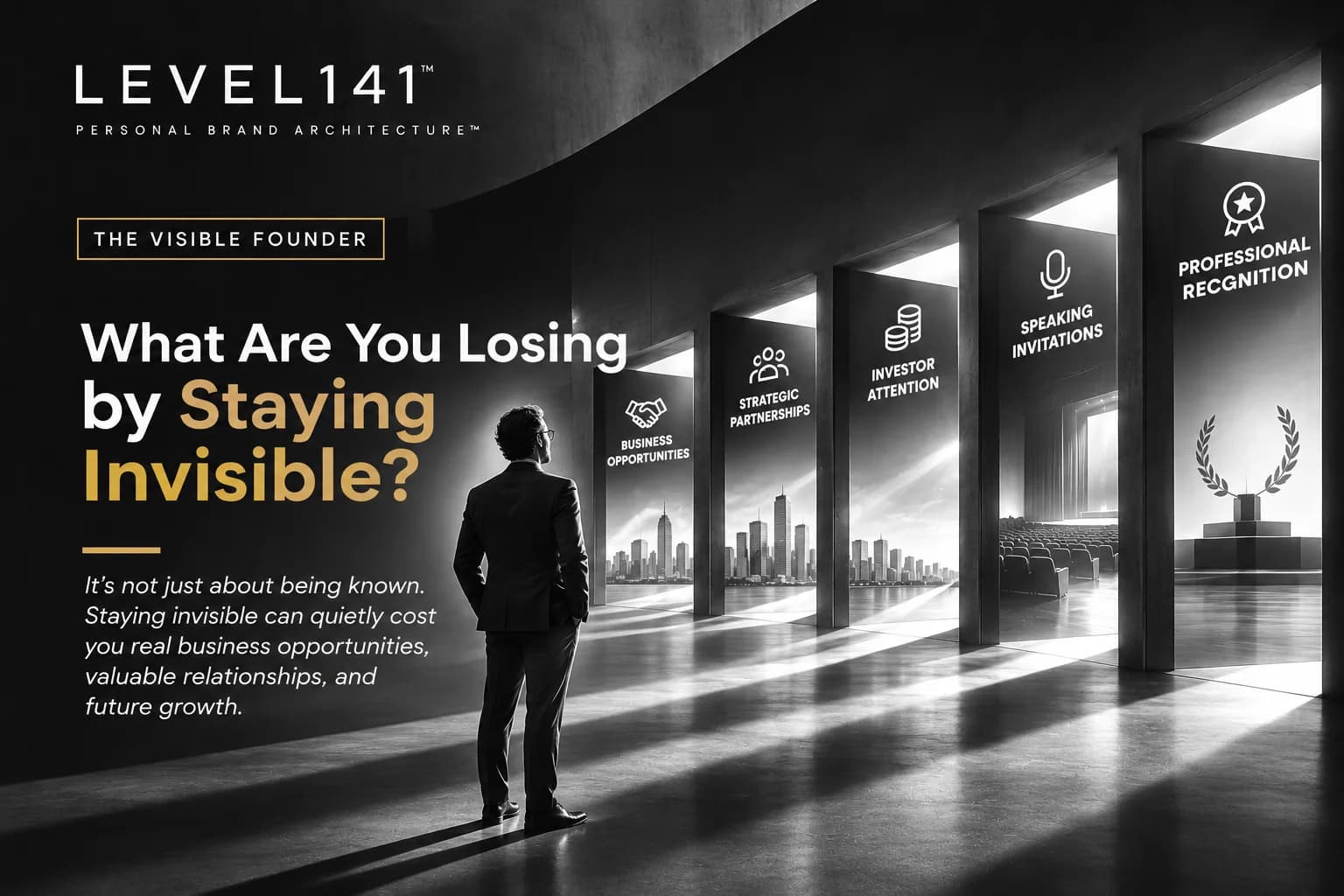
What Are You Losing by Staying Invisible?
The biggest opportunities you miss are often the ones you never knew existed.
Read the article